How to Size an Expansion Tank for Hydronic Heating Systems — Manufacturer Guide
Answer in brief
Size a closed-loop hydronic expansion tank from the system’s actual fluid volume, the fluid’s expansion between fill and maximum temperature, the cold fill pressure at the tank connection, and the relief-valve setting. First calculate the volume the tank must accept; then convert that acceptance requirement into nominal tank volume using absolute pressure, not gauge pressure alone. Set the tank pre-charge to the required cold fill pressure only after isolating and draining the water side. Glycol mixtures, tall buildings, high operating temperatures, and uncertain system volumes require project-specific data rather than a shortcut table. Select the next standard tank size whose published acceptance volume meets or exceeds the calculation, while remaining within its temperature and pressure ratings. A moderately larger tank can provide operating margin, but it does not replace correct pre-charge, installation, or relief-valve selection. For final procurement, verify capacity, connection, orientation, diaphragm material, temperature rating, maximum allowable pressure, and applicable documentation against the chosen model.
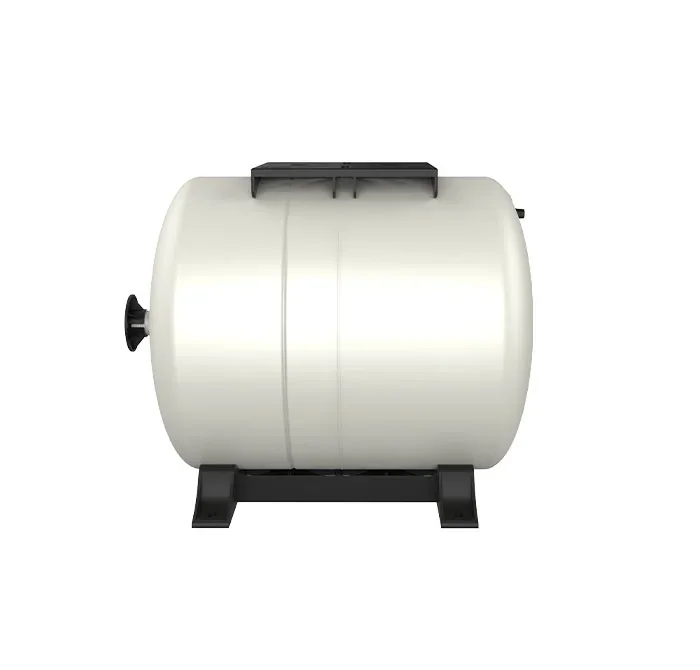
Every closed-loop hydronic heating or cooling system needs an expansion tank. Without one, thermal expansion of the system fluid creates pressure spikes that can trigger the pressure relief valve — or worse, damage pipes, boilers, and seals. But sizing an expansion tank correctly is not guesswork: it is a straightforward engineering calculation governed by basic thermodynamics.
In this guide we walk through the complete sizing procedure used by HVAC engineers worldwide. Whether you are specifying a tank for a single-family home or a commercial boiler plant, the same principles apply — only the numbers change.
Key takeaway: An undersized expansion tank cannot absorb the full thermal expansion volume, causing the system pressure to rise until the relief valve opens. An oversized tank wastes money but causes no functional harm — so when in doubt between two sizes, choose the larger one.
1. Why Expansion Happens
Water expands when heated. In a hydronic heating system, the water temperature typically cycles between ambient (say 10°C / 50°F when cold) and operating temperature (typically 80–90°C / 176–194°F for residential systems, up to 120°C / 248°F for commercial). The volume change is small per liter — but in a system containing hundreds or thousands of liters, the total expansion can be substantial.
Because water is essentially incompressible, that extra volume has nowhere to go in a rigid closed loop. The expansion tank provides a compressible air or nitrogen cushion separated from the system water by a flexible diaphragm. As the water expands, it pushes against the diaphragm, compressing the gas on the other side and keeping the system pressure within safe limits.
2. The Sizing Formula
The industry-standard formula for expansion tank sizing comes from ASHRAE Handbook — HVAC Systems and Equipment and is used by manufacturers worldwide:
Where:
- Vtank = Required expansion tank volume (liters or gallons)
- Vacc = Acceptance volume — the volume of expanded water the tank must absorb (liters or gallons)
- Prelief = Pressure relief valve setting (bar gauge or psig)
- Patm = Atmospheric pressure (1.013 bar = 14.7 psi)
- Pfill = Cold fill pressure at the tank location (bar gauge or psig)
This formula tells you the total tank volume needed. The tank you select should have a nominal volume equal to or greater than Vtank.
3. Step-by-Step Calculation Procedure
Step 1: Determine System Water Volume (Vsys)
First, calculate how much water the entire closed loop contains. This includes the boiler, piping, radiators/fan coils, and any buffer tanks. Use this quick-reference table for estimation:
| Component | Water Volume (liters per unit) |
|---|---|
| Residential boiler (wall-hung, 24–35 kW) | 3–6 L |
| Commercial boiler (cast-iron, per 100 kW) | 40–80 L |
| Steel panel radiator (per kW output) | 3–4 L |
| Fan coil unit (per kW) | 0.5–1.5 L |
| Underfloor heating pipe (16 mm OD, per meter) | 0.11 L |
| Steel pipe DN25 (1″) — per meter | 0.49 L |
| Steel pipe DN50 (2″) — per meter | 1.96 L |
| Steel pipe DN80 (3″) — per meter | 5.0 L |
Step 2: Calculate Thermal Expansion Volume (Vexp)
The amount of expansion depends on the temperature rise (ΔT) from cold fill to maximum operating temperature. Use these water expansion coefficients:
| Temperature Range | Expansion Coefficient (ε) |
|---|---|
| 10°C → 60°C (50°F → 140°F) | 0.017 (1.7%) |
| 10°C → 80°C (50°F → 176°F) | 0.029 (2.9%) |
| 10°C → 95°C (50°F → 203°F) | 0.040 (4.0%) |
| 10°C → 120°C (50°F → 248°F) | 0.060 (6.0%) |
For systems with glycol (antifreeze), multiply the expansion coefficient by 1.2 to 1.5 depending on glycol concentration, since glycol-water mixtures expand more than pure water.
Step 3: Determine Acceptance Volume (Vacc)
The acceptance volume is the amount of expanded water the tank must actually accept. For a standard diaphragm expansion tank, Vacc = Vexp. Some engineers add a small safety factor of 10–25% for system dynamics.
Step 4: Determine Pressures
- Prelief — Read from the pressure relief valve rating. Common residential values: 3.0 bar (43.5 psig). Commercial: 4.0–6.0 bar (58–87 psig).
- Pfill — Cold fill pressure at the expansion tank location. This equals the static head pressure (height of the highest point above the tank × 0.0981 bar/meter) plus a minimum operating pressure of 0.5–1.0 bar to prevent pump cavitation and air ingress.
Step 5: Calculate Required Tank Volume
Plug all values into the main formula. This gives you the minimum tank volume. Select the next standard size above your calculated value.
4. Worked Example: Residential House
Scenario: A 200 m² (2,150 sq ft) two-story house with underfloor heating on the ground floor, radiators upstairs, and a 30 kW wall-hung gas boiler. The expansion tank is mounted in the basement, and the highest radiator is 6 meters above the tank.
| Parameter | Value | How Determined |
|---|---|---|
| Vsys (system volume) | 185 L | Boiler 5L + 100m² UFH pipe 11L + 8 radiators 24L + piping 145L |
| ΔT (temp rise) | 70°C (10→80°C) | Standard residential heating design |
| ε (expansion coeff) | 0.029 | From table above |
| Vexp | 5.37 L | 185 × 0.029 |
| Vacc | 5.90 L | 5.37 × 1.1 (10% safety) |
| Prelief | 3.0 bar | Standard residential PRV |
| Pfill | 1.09 bar | (6m × 0.0981) + 0.5 |
Result: Select a standard 18-liter or 24-liter diaphragm expansion tank. HM Tanks model FT-18L (18L, 10 bar max) or FT-24L (24L) would both work; the 24L provides extra capacity for future system modifications.
5. Worked Example: Small Commercial Building
Scenario: A 3-story office building with a 300 kW commercial boiler plant serving fan coil units throughout. Expansion tank located in the basement plant room, highest FCU is 12 meters above.
| Parameter | Value |
|---|---|
| Vsys | 2,400 L |
| ε | 0.029 (10→80°C) |
| Vexp | 69.6 L |
| Vacc | 76.6 L (with 10% safety) |
| Prelief | 4.0 bar |
| Pfill | 1.68 bar ((12 × 0.0981) + 0.5) |
Result: Select a 200-liter expansion tank, or install two 100-liter tanks in parallel for redundancy. HM Tanks offers fixed-diaphragm models from 2L to 500L, and can supply parallel tank skids for larger systems.
6. Quick-Reference Sizing Table
For typical residential and light commercial hydronic systems (80°C max, 3 bar PRV, 6m static head), use this simplified reference:
| System Volume (L) | Recommended Tank Size (L) | Typical Application |
|---|---|---|
| Up to 100 | 8–12 | Apartment, small house |
| 100–200 | 12–18 | Medium house with radiators + UFH |
| 200–400 | 18–35 | Large house, small commercial |
| 400–800 | 35–60 | Small office, retail |
| 800–1,500 | 60–100 | Medium commercial building |
| 1,500–3,000 | 100–200 | Large commercial, industrial |
| 3,000–5,000 | 200–350 | District heating substation |
Important: This table assumes standard conditions. Always perform the full calculation for systems with glycol, high-rise buildings (>15m static head), or operating temperatures above 90°C. Contact the HM Tanks engineering team at info@huimay.cn for project-specific sizing support — we provide this free of charge to our customers.
7. Fixed vs Replaceable Diaphragm: Which to Choose?
Once you have the required volume, you also need to select the right type of expansion tank:
| Feature | Fixed Diaphragm | Replaceable Diaphragm |
|---|---|---|
| Initial cost | Lower | Higher (20–40% more) |
| Service life | 10–15 years | 20+ years (membrane replaceable) |
| Maintenance | None — sealed unit | Periodic inspection recommended |
| Typical sizes | 2L–500L | 35L–5,000L |
| Best for | Residential, light commercial | Commercial, industrial, critical systems |
HM Tanks manufactures both types. Our fixed-diaphragm tanks feature 304 stainless steel water connections and a butyl rubber diaphragm rated for continuous operation at 90°C. Our replaceable-diaphragm tanks use a bolted flange design that allows membrane replacement without removing the tank from the system — a major labor-saving feature for large installations.
8. Common Sizing Mistakes to Avoid
- Forgetting the static head. The fill pressure at the tank location is NOT the same as the pressure at the boiler. If the tank is in the basement and the highest point is 20 meters up, Pfill must include the full 1.96 bar of static head.
- Using the wrong expansion coefficient. Glycol-water mixtures can expand 50% more than pure water. If your system contains antifreeze, adjust ε accordingly.
- Ignoring the pre-charge pressure. The tank's factory pre-charge (usually 1.5 bar for residential tanks) must be adjusted to match Pfill before installation. A tank with too-high pre-charge will not accept water until system pressure already exceeds safe levels.
- Confusing tank volume with acceptance volume. A "35-liter" expansion tank does NOT accept 35 liters of expanded water. The acceptance volume is always less than the nominal volume, because the gas cushion needs room to compress. Always use the sizing formula; do not simply match Vacc to nominal tank size.
- Sizing for average conditions only. Size for the worst-case scenario (coldest fill temperature, highest operating temperature). The cost difference between a correctly-sized tank and an undersized one is small; the cost of system damage from an undersized tank is not.
9. Need Help? We Size Tanks for Free
At HM Tanks, we provide complimentary expansion tank sizing calculations for our OEM, wholesale, and distributor customers. Simply send us your system parameters — total water volume, maximum operating temperature, building height, and relief valve setting — and our engineering team will return a detailed sizing report within 1 business day, including product recommendations and a dimensional drawing showing connection details.
Contact us: info@huimay.cn | +86-189-179-05624 | Inquiry Form
Primary sources and verification
These first-party sources explain the referenced standard or engineering method. They do not independently validate a specific product model or supplier claim.